Copyright National Art Education Association Jul 2002| [Headnote] |
| One of the most relevant considerations in education and art education today is how the use of computer technology affects teaching and learning. More specifically, art educators are becoming more concerned with how the use of computer technology informs our own educational practices (Dunn, 1996; Gregory, 1996; Heise & Grandgennett, 1996; Prater, 2001; Taylor, 1999; Wilson, 1998). In this article, we discuss the ways that interactive computer technology, specifically hypertext, facilitates an intertextual approach to the practice of creating and teaching thematic units of instruction in K-12 art classrooms. |
Intertextuality
Intertextuality1 refers to the discovery and creation of new ideas that are made through examining relationships. An authentic intertextual "reading" may serve to deepen and more profoundly influence a learning experience. Wilson (1994), referring to Rorty (1979), reminds us that such an approach to the creation and interpretation of a work of art as text should occur with the hope that it will help students to want something different-that it will help them to change their purposes and thus change their lives.
Taking an intertextual approach to the study of art may be disconcerting to many whose experiences are based on linear, organized, and hierarchical exactitudes. Vast connections and considerations can be confusing to say the least. What is needed, however, is more than just a tool or instrument to organize this intertextual approach. What we need is an apparatus that provokes and promotes intertextual thinking.
Hypertext
The term hypertext2 is used to describe any computer program or application that involves linking and connecting. The World Wide Web (WWW) on the Internet is composed of documents that have been written in a hypertext markup language (html) that defines everything from links to type style and size. Basic hypertext applications such as the software "Hypermedia" and "Hypercard" allow the writer to create a series of linked cards that the reader accesses by clicking on certain "hot buttons." "Powerpoint" presentations are hypertextual as are "Inspiration" concept web models. "Storyspace" is a computer application that involves the use of boxes, called writing spaces or lexia that contain information and other boxes of information that may include written text, images, sound, and video. These boxes and/or key words, phrases, images, or parts of images may be linked to form associative and connective paths throughout the web. Unlike the WWW and "Hypercard," "Storyspace" provides three possible overviews of a constructed web. These three overviews are the chart view, the outline view, and the "Storyspace" view, which consists of a graphic representation of writing spaces as boxes and links as arrows. Through each of these views, both reader and writer can see, access, and comment directly on any or all parts of the constructed web. In other words, the reader is not blindly following links as on WWW pages and buttons on "Hypercard" files.
"Storyspace" readers see and access links in whatever order they choose as well as create their own paths and add information throughout the web. In doing so, readers change the structure of the original web, making it more than it was before they encountered it. In other words, new ideas may be discovered or even provoked through this hypertextual process of inventively linking resulting in an authentic intertextual reading.
Inter/hypertextual Units of Instruction
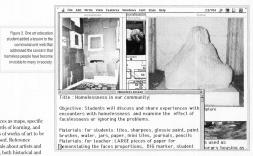
Communal unit. "Sharing a Place Called Home" is a unit of instruction for elementary school students created by art education university majors with the hypertext computer software "Storyspace." The unit overview space features the title of the unit, a brief description of the objectives, and a list of lesson titles or questions such as "What constitutes a home? Who lives there? Who doesn't? Is a house always a home? What is homelessness?" (See Figure 1.) Each of these questions links to a writing space in the Storyspace unit web that contains a lesson plan following a fairly traditional format of objectives, resources, student materials, motivation, procedure, anticipation, reflection, and evaluation. Links from these spaces take the reader to such resources as maps, specific standards of learning, and images of works of art to be discussed. Reference materials about artists and events both historical and contemporary, as well as links to such popular culture as television commercials and movie clips are included. Other links are made to spaces containing examples of the projects and activities, assessment strategies, rubric formulation, other works of art, stories, poems, literature, and newspaper articles.
Art education students expanded each lesson plan by inventively linking them to other ideas, issues, and activities. For example, one student used a sculpture depicting a human being crouching and shrouded in a blanket. (See Figure 2.) Her lesson addressed the concern that homeless people have become invisible to many in society. She linked her lesson to an image of a man sleeping on a park bench and a space containing critical writings concerning invisibility along with data concerning the homeless issue in the United States. Linking her lesson to current events, she created a space with a photograph of tents used as temporary housing for people displaced by earthquakes in Turkey and continued a linking path to a world map. She created and taught a lesson to young students where they "put a face on the homeless" by practicing facial proportion techniques and creating ceramic tiles along with "empty picture frames" where young students used text to describe stereotypes of homelessness. These tiles and frames became a part of an exhibition installation where a section of a gallery was covered with cardboard, a reference to the stereotypical box houses associated with the homeless. The empty frames hung on the cardboard in such a way that visitors had to intentionally step on the tiles (the faces of the homeless) in order to read the text. Throughout her lesson spaces in the communal unit web, this art education student created links back and forth to other lessons (created by other art
 | |
education students) revealing the ways that she and her future students could review and understand the connections and comparisons throughout the unit of instruction.
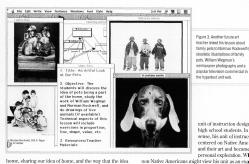
Another student linked his lesson about family pets to the question of "What constitutes a home?" He used both Norman Rockwell's idealistic illustrations of family pets and William Wegman's weimaraner photographs to question as well as extend our idea of identity and home. He created and taught a lesson that involved his students in questioning the way these artists explored the idea of pets and linked his lesson to a popular television commercial (stored as a short movie clip in the computer hypertext unit web) (see Figure 3). During an after-school class, students then created charcoal drawings of a rabbit and two dogs that patiently sat in cages and on pillows in the middle of tables. He linked various parts of his lesson with another lesson concerning differing cultural values of animals and home including the sacredness of the cow in Hinduism.
Other lessons in this unit web included metaphor and symbolism of home such as the ways that shoes reflect the idea of home in art and popular culture (i.e. Dorothy's ruby slippers in the Wizard of Oz, Van Gogh's A Pair of Shoes, and artist Sherrie Levine's 2 Shoes). Students created lessons concerning home interiors as self-reflection, the spirit of the home, sharing our idea of home, and the way that the idea of home is significant in folk and craft art. Throughout the semester, these art education students continued to add information, links, and ideas in this ever-evolving and growing unit of instruction.
 | |
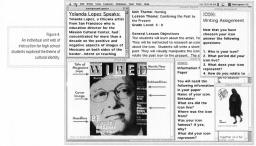
Individual units. One art education student created a hypertextual unit of instruction for high school students that explored the theme of cultural identity (see Figure 4). Her second unit of instruction was based on the sub-theme, "Naming," which she borrowed from a chapter of the same name in Lucy Lippard's (1990) book, Mixed Blessings. The central artwork for this unit is a magazine cover created by artist Yolanda Lopez for Fem, a Mexican feminist magazine. From this work, this future art teacher made numerous connections that focused on the concepts of how people and their images can serve as powerful icons in culture and society. The central learning objectives for one of the lessons in this unit required high school students to relate to an icon from the past by making the icon relate to the present and to manipulate the appearance of the past icon in a contemporary way.
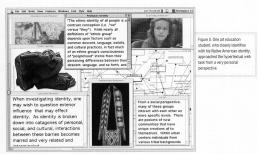
Three other art education students decided to create their individual units of instruction on the class-developed theme of personal, cultural, and social identity. One future teacher, who closely identifies with his Native American identity, approached this assignment from a very personal perspective (see Figure 5). His own knowledge and connections with his immediate and extended family informed his unit of instruction designed for high school students. In a broader sense, his unit of instruction centered on Native Americans and their art and became one of personal exploration. While non-Native Americans might view his unit as an example of cultural identity, his own perspective was more close to his heart, and in as much, his unit actually spans personal, cultural, and social identity classifications. Another art education student began her unit of instruction with the slogan "Black is Beautiful" and an image of the same title by artist Elizabeth Catlett. While her initial response to this work took the form of a phrase "Defining Yourself as an Ideal," this future art teacher moved away from personal identity and toward a focus on cultural identity and related issues that would be relevant to her future high school students. A third art education student used works of art and imagery from popular culture including Frida Kahlo, advertising and media, Audrey Flack, stereotypes, hip-hop culture, and clothing.
Computer as catalyst. Prior to these experiences, students in our art education classes rarely created units of instruction with such an expanse of information or depth of analysis and connection as is evident in these examples. Their traditional unit plan notebooks may have, on occasion, included an interdisciplinary connection between an art lesson and another subject in school. Because the notebooks were static, changing, adding information or allowing for the unit to move in an entirely different direction was never an option. It was the computer, the hypertext software, and the inventive ways of thinking and knowing that inspired and indeed provoked these future art teachers to work and think intertextually.
Inter/Hypertextual Thematic Units of Instruction
We have found that a thematic approach to the creation of hypertext units of instruction provides an excellent opportunity to present and facilitate intertextual connections. Through the use of hypertext, intertextual links can be discovered between the study of art (aesthetics, criticism, cultural issues, historical information, and artmaking) and other realms of experience in and outside of school. Based on ideas that relate to human experiences, art education thematic units of instruction are typically artwork centered and include a range of lessons involving students and teachers in historical inquiry, interdisciplinary connections, artmaking, technique and media exploration.
 | |
The choice of works of art that encourage authentic intertextual experiences should be narratively complex and challenging but not too conceptually dense or difficult to decipher (Carpenter, 1999). We have found that the best works of art for this approach require students to make a range of connections to other texts, subject areas, and bodies of knowledge. It is also helpful to select works that are easily accessible and about which much has been written. Because a key goal of interpretation is to literally construct meaning by building connections from a work of art to other texts (Barrett, 1994; Carpenter, 1996), students should be encouraged to ask questions and offer uncertainty about the meanings of works of art. References should be established to the cultural contexts in which the work, the artist, the historians, and the critics exist. Visible signs in the works can be actively, consciously, and inventively linked and translated into critical verbal and written interpretations.
In such a learning environment, students and teachers construct interpretations based on their own frames of reference and sets of knowledge. Initial interpretations can be combined and linked with others to produce more complex interpretations and understandings. As art education students and teachers move from one unit to the next, they should revisit questions, themes, and information revealed through interpretations of works of art studied in previous units.
Traditional linear approaches to curriculum design and interpretation may make hypertextual reading seem awkward at first. When teachers and students are encouraged to refer to essential questions at any time during the reading or writing of a document, they learn to more easily navigate the complexities of hypertextual units. Collaborative activities as well as working from templates designed by instructors may assist the teaching of computer hypertextual unit formulation.
Hypertextual Teaching and Planning
One way to approach the formulation of hypertextual units of instruction is through collaboration. Beginning with the study and interpretation of a work of art, teachers and art education students work together to distinguish the major human relational ideas represented in the artwork. From these ideas they develop a theme for the unit of instruction and learning goals and objectives linked directly to national, state, and district standards and curriculum. Teachers then create individual lessons that support these goals. They work together to type, paste, and import data into the communal hypertext unit web and in the process discover and make links to resources (maps, charts, WWW links, vocabulary, critical writings, information about artists, films, student examples, and procedural directions), other lessons, other ideas, other works of art, and other experiences.
 | |
Teachers and art education students may also begin formulating hypertextual units of instruction by completing templates. Templates may contain spaces for lessons, resources, vocabulary, other disciplines, and popular culture. Links may be made between the spaces as teachers discover and ponder new ideas and connections between the information and activities involved in their units of instruction.
Another way to begin the process is through communal introductory activities that involve tasks to further teachers' and art education students' understanding of intertextuality. For example, they may construct a web that centers on the same work of art. Teachers and art education students may read critical essays written about the artist and the work. From these essays they may then complete a task that involves making thematic, technical, and contextual connections from the work of art to other information and begin the unit web-building process.
A third form of an introduction task requires teachers and art education students to start with a blank template in which they organize the unit around a work of art or one or more themes. Prior to beginning the introduction task, they work in collaboration to interpret a work of art for the purpose of developing a list of plausible themes. Next, working individually, teachers and art education students decide for themselves whether to place the initial work of art or one of the generated themes in the center of their unit template. They then make two or more specific connections to visual, thematic, technical and contextual content. For their individual unit webs, teachers and art education students elect whether to continue developing their introduction task web or to begin working on a new web originating from a different work of art or theme. In either case, these individual webs later develop into units of instruction.
Conclusion
A hypertextual approach to inquiry requires that teachers and students draw upon their knowledge of other works of art, school subjects, and "real world" sources in order to support their interpretations. Through an intertextual approach a student or teacher easily leaps from and blends together knowledge from past lived experiences, observations, and multiple disciplines through specific texts simultaneously.3
Because hypertext allows the creation of a visual document of the interpretations created by each individual, teachers and art education students actually "see" the relationships among various parts of their hypertextual units of instruction. Such a hypertextual and collaborative approach to interpretation, what McRorie (Hagaman) called "community of inquiry" (Hagaman, 1990), is built electronically and mapped without disrupting the flow of interpretation or discussion. We have found that these hypertextual unit webs also inform the instruction of art criticism, art history, and aesthetics methods, while at the same time contribute to our art education students' understanding of the best practices for teaching critical thinking through interpretation. Just as we have found these hypertextual approaches useful, so have our art education students, as evidenced in the following quote posted online in the discussion area of one of our secondary art education courses:
 | |
Hypertext not only organizes the teacher in that we are encouraged to see the connections between subject areas, and open doors in connecting learning, but it also inspires new ideas in the classroom. In responding to a work of art I guarantee that no two people will find the same exact responses in their research because we bring with us meaning to the art as well. This goes double for our students, in that they will teach us a new perspective. Hypertext also allows for constant growth, the possibilities are endless, and this is conducive for productive learning in that there is no "end."
It is also important to note that art education students and teachers may continually change and remake their unit plans through the "Storyspace" web. Hypertext serves as a way to see change as well as perpetuate growth and connections with its ever-increasing opportunities for new ways of knowing (Taylor, 2000). Hypertext may provide the space, the site, and the tool for revealing to students and teachers alike that learning is not static, but constantly in a state of change and growth. Through this change and growth could emerge a new way of knowing that becomes a part of the students and the teachers, changes them, and constantly redefines their human experience.
| [Footnote] |
| 1French semiotician Julia Kristeva used the term intertextuality to explain that all signifying systems are made up by the way in which they affect earlier signifying systems (Kristeva, 1980). In other words, a work of art or literature is not the product of a single artist or author, but of its relationship to other information, ideas, or works of art, known as "texts" (Keep & McLaughlin, 1995). |
| 2Vannevar Bush (1945), Director of the U.S. National Office of Scientific Research and Development, is said to have begun the notion of hypertext. He challenged the scientific community to continue their research and discovery (after WW II) by proposing that they attend to the facilitation of storing and retrieving information. He imagined a mechanically linked information-retrieval machine, called a "memex." Twenty years after Bush first envisioned his memex, Theodor Nelson echoed the idea for a systematic framework to hold and deal with ideas and their relationships. His system, known as Project Xanadu, became enabled through the evolution of computer technology. Nelson referred to his system as "hypertext" and explained it as text that branches and allows choices "connected by links which offer the reader (and creator) different pathways" (Landow, 1992, p. 4). |
| 3When information is connected among and between school subjects it is thought of as interdisciplinary. We consider the convergence of constructivist and interdisciplinary inquiry to be intertextual. It is the act and process of engaging in this type of intertextual inquiry that is crucial to the development of rich, meaningful thematic inquiry and instruction. We have found that the use of computer hypertext not only facilitates this process, it compels it. |
| [Reference] |
| Barrett, T. (1994). Principles for interpreting art. Art Education 46(1), 8-13. |
| Bush, V. (1945). As we may think. The Atlantic Monthly. [Online]. Available: http://ccat.sas.upenn.edu/jod/texts/vannevar.bush.html [1997, February 31. |
| Carpenter, B. S. (1996). A meta-critical analysis of ceramics criticism for art education: Toward an interpretive methodology. Unpublished doctoral thesis. The Pennsylvania State University. |
| Carpenter, B. S. (1999). Art lessons: Learning to interpret, Educational Leadership, 57 (3), 46-48. Alexandria, VA: Association for Supervision and Curriculum Development. |
| [Reference] |
| Dunn, P. (1996). More power: Integrated interactive technology and art education. Art Education, 49(6), 611. |
| Gregory, D. (1996). Art education reform: Technology as savior. Art Education, 49(6), 49-54. |
| Hagaman, S. (1990). Aesthetics in art education: A look toward implementation. ERIC Digest EDO-SO-90-11, December. |
| Heise, D. & Grandgenett, N. (1996). Perspectives on the use of internet in art classrooms. Art Education, 49(6), 12-18. |
| Keep, C. & McLaughlin, T. (1995). Intertextuality. The electronic labyrinth [Online]. Available: |
| http://jefferson.village.virginia.edu/elab/hf10278.html [1997, March 30]. |
| Kristeva, J. (1980). Desire in language: A semiotic approach to literature and art. (Alice Jardine,Thomas Gora and Leon Roudiez, Trans.). New York: Columbia University Press. |
| Landow, G. P. (1992). Hypertext: The convergence of contemporary critical theory and technology. Baltimore: The Johns Hopkins Press. |
| Lippard, L. R. (1990). Mixed blessings: New art in a multicultural America. New York: Pantheon Books. |
| Prater, M. (2001). Constructivism and technology in art education. Art Education, 54(6), 43-48. |
| Rorty, IR (1979). Philosophy and the mirror of nature. Princeton, N J: Princeton University Press. |
| Taylor, P. G. (2000). Madonna and hypertext: Liberatory learning in art education. Studies in Art Education, 41(4), 376-389. |
| Taylor, P.G. (1999). Hypertext-based art education: Implications for liberatory learning in high school. Unpublished doctoral thesis. The Pennsylvania State University. |
| Wilson, B. (1994). Reflections on the relationships among art, life, and research. Studies in Art Education, 35 (4), 197-208. |
| Wilson, M. (1998). The text, the intertext and the hypertextual: A story. Keynote address delivered to the Virginia Art Education Association. |
| [Author Affiliation] |
| Pamela G. Taylor is Assistant Professor ofArt Education at the University of Georgia, and B. Stephen Carpenter, II is Associate Professor ofArt Education at Virginia |
| Commonwealth University. E-mail: pgtaylor@uga. edu. Or: bscarpenter@ucu.edu |


 My Research